
反击
痛心!留学生文文已确认遇害,年仅25岁;遗体已被找到,原计划三天前去新单位入职_我的网站

一 |
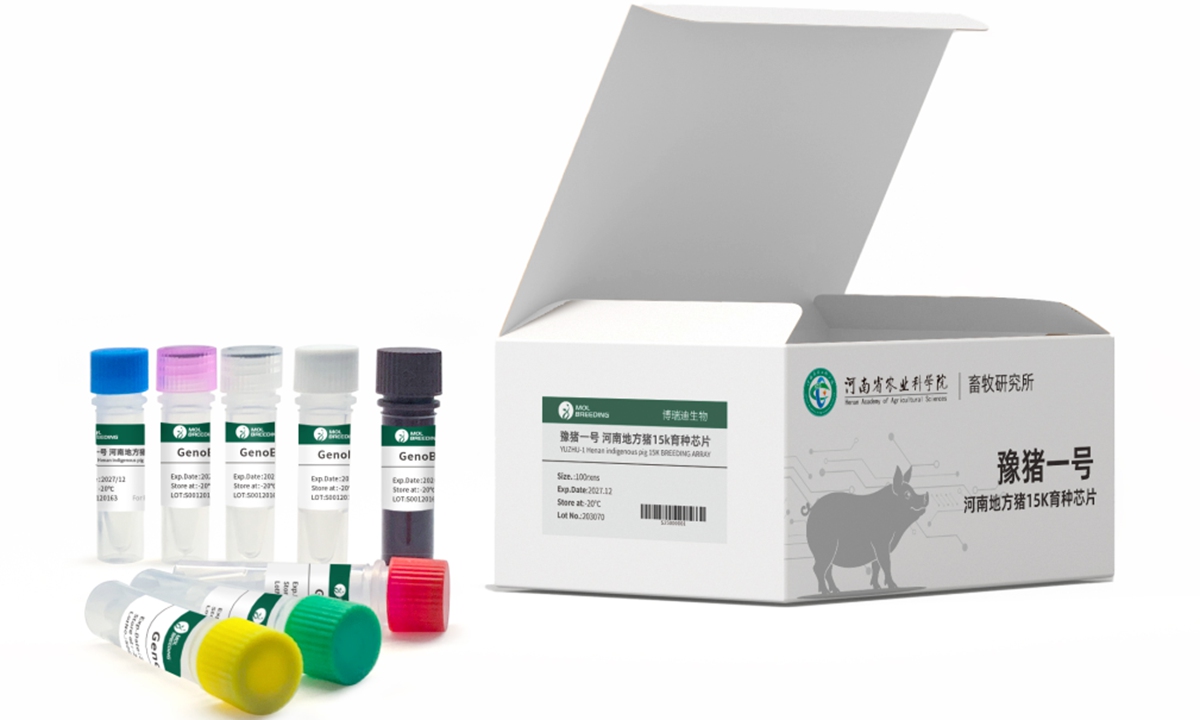
China's largest pork-producing province has introduced a genomic breeding tool designed for indigenous pig breeding, a sign that the province is shifting from expanding volume toward improving hog quality.
The Henan Academy of Agricultural Sciences announced the launch of Yuzhu-1 Henan indigenous pig 15k breeding array - commonly known as a gene chip - developed by the pig breeding team at its Institute of Animal Husbandry and Veterinary Science. It is the first such tool customized for the province's native pig stock, the institute said on Monday.
Henan is home to multiple native pig breeds prized by consumers for their good flavor. However, they carry a commercial burden compared with imported lean-meat breeds, as they grow more slowly, consume more feed per kilogram of weight gain and deliver thinner margins, noted Xing Baosong, head of the pig research office at the institute.
Lifting those hurdles depends on sharper selection, which in local herds has long relied on visual assessment of physical traits, which is slow and imprecise. Genomic tools can speed things up, but mainstream commercial chips were built on imported breeds and lose accuracy on native Chinese stock. Yuzhu No 1 instead draws on whole-genome resequencing data from five of Henan's native pig breeds and two locally bred lines.
"In breeding we rely on estimated breeding values to judge an animal's genetic potential," Wang Ligang, a professor at the Institute of Animal Sciences under the Chinese Academy of Agricultural Sciences, told the Global Times on Monday. "An array matched to the breed makes that estimate more accurate. Previously there was a real chance we were selecting the wrong animals. Now we are far more likely to be selecting the right ones - and to select accurately for the traits a breed is known for, whether that is tender meat or high fertility."
The efficiency gap between native and imported pig breeds remains wide, said Wang, who is also with the Pig Branch of the Chinese Association of Animal Science and Veterinary Medicine. Feed conversion ratios for local Chinese pigs run around 3.0, against below 2.5 for imported breeds, while reaching 100 kilograms takes native pigs 180 to 190 days compared with 130 to 140 days for exotic lines, he said.
Despite this, China's native pig breeds have their advantages.
"Our pigs taste better, partly because they are raised longer," Wang said. "And they are far more robust. Exotic breeds can suffer heat stress and die in summer; when disease hits, they can go down in large numbers. Local pigs rarely do. They tend to recover. Some breeds in Northeast China can even tolerate severe cold."
He added that imported breeds drive efficiency, while native breeds ensure quality and offer a reservoir of genetic diversity for disease and stress resistance - traits that can be bred back into commercial lines.
The province slaughtered 64.74 million pigs in 2025, up 7.4 percent year on year, with pork output at 5.22 million tons, according to the provincial statistics bureau, making it the top pork and pig producer nationwide, according to industry statistics.
In the first half of 2026, pig slaughter in the province rose a further 6.4 percent, accelerating 5.3 percentage points from the first quarter, against national growth of 1.7 percent. Xing said that more high-quality local black pigs will reach the market as Yuzhu No 1 is applied more broadly.
Other major pig production provinces such as Southwest China's Sichuan, Northwest China's Shaanxi and South China's Yunnan have all developed their own arrays.
"Provinces with the most developed pig production are the ones pushing upmarket," Wang said. "Scale is no longer the only measure. If every province reaches this level, a pattern of one dedicated array per province could gradually take shape for China's native breeds."
。 评论 发表。

二 |
Current article:http://hry6ta.dingruorenhongqiaminmeipeiliu.cyou/j0fm0i/13co.xls
Published on:05:23:10
上一篇:财政金融协同促内需一揽子政策已惠及企业622万家、居民1.13亿人次 下一篇:3 dead after partial residential building collapse in north China’s Shijiazhuang
我的网站相关阅读
- 祝福祖国 多彩活动为祖国庆生
- Ring 0级固件威胁:新型UEFI rootkit恶意软件BlackLotus曝光
- “十五五”开局看河北|以展兴业,释放会展经济“强磁力”
- Xi'an to host the 4th International Elderly Industry Expo in September
- Chinese 'worst' movie 'Niu Lai' becomes a unlikely global hit, surpassing 40 million yuan at box office
- Alphabet把Gemini刻进了硅片
- 比尔·盖茨称欧洲能源危机“从长远看是好事”,引发关注和争议
- Nivetha Thomas Calls Out Misuse of AI Generated Images and Warns of Legal Action
- Aneet Padda to Shoot for Shakti Shalini Right After College Exams
我的网站最新文章
- 特朗普被判有罪成定局?民众压倒性支持定罪!
- 潮友社,疏解企业青年来相聚
- 권칠승 "종부세는 보유세, 비거주 페널티는 양도세로 풀어야"
- Chinese female student missing in South Korea for days found dead, man in 30s arrested: consulate general
- 注意:洗衣机上的干洗羽绒服可能会爆炸。
- 北京首条跨省地铁空载试运行:燕郊到东三环仅需20多分钟
- 广东省广州市委原常委、政法委原书记谢晓丹严重违纪违法被开除党籍和公职_处分法_问题
- SNAP面临着集体诉讼:原因是为了隐瞒IPO的真实生活。
- 1 dead, 2 injured by gunshots near a pro-democracy protest in Guatemala
- 英俊的炸弹!日产新概念电动汽车IMS:612公里
- 네팔 홍수로 한국인 8명 연락 두절…10명 고립
- ATP马德里大师赛签表出炉,布云朝克特首轮抽到资格赛选手
- 运动基因丝毫不减!实测宝马X5综合性能
我的网站随机推荐
- ‘Pay to suffer’: German fitness race Hyrox taps China’s appetite for fitness and social connection
- 高通妙龙675跑出炉子:174402点,略高于妙龙710点。
- 奥比-马丁:加盟曼联绝对是正确选择,首秀确实是非常重要的时刻
- 再创新高 鸿蒙智行5月交付新车破4.4万辆 尊界S800大定破1600台
- 市场监管总局就国际单位制及其应用向社会公开征求意见
- 민주 "국힘 연찬회에 박근혜...다음은 윤석열인가"
- Redmi Red Rice注7:下一代Chin靠近iPhone X
- 欧洲联赛主席:改革FIFA这套全球管理体系远比换掉因凡蒂诺更关键
- 青海海东市发现2名核酸检测阳性人员_隔离_陈艳婷
- ATP1000马德里大师赛签表:德约科维奇vs德雷珀,鲁内vs弗里茨
- 马斯克:特斯拉完全自动驾驶今年无法获批
- 让每个人都有机会——高新区(滨江)AI全链生态圈共富观察
- 漫画台湾丨机关算尽